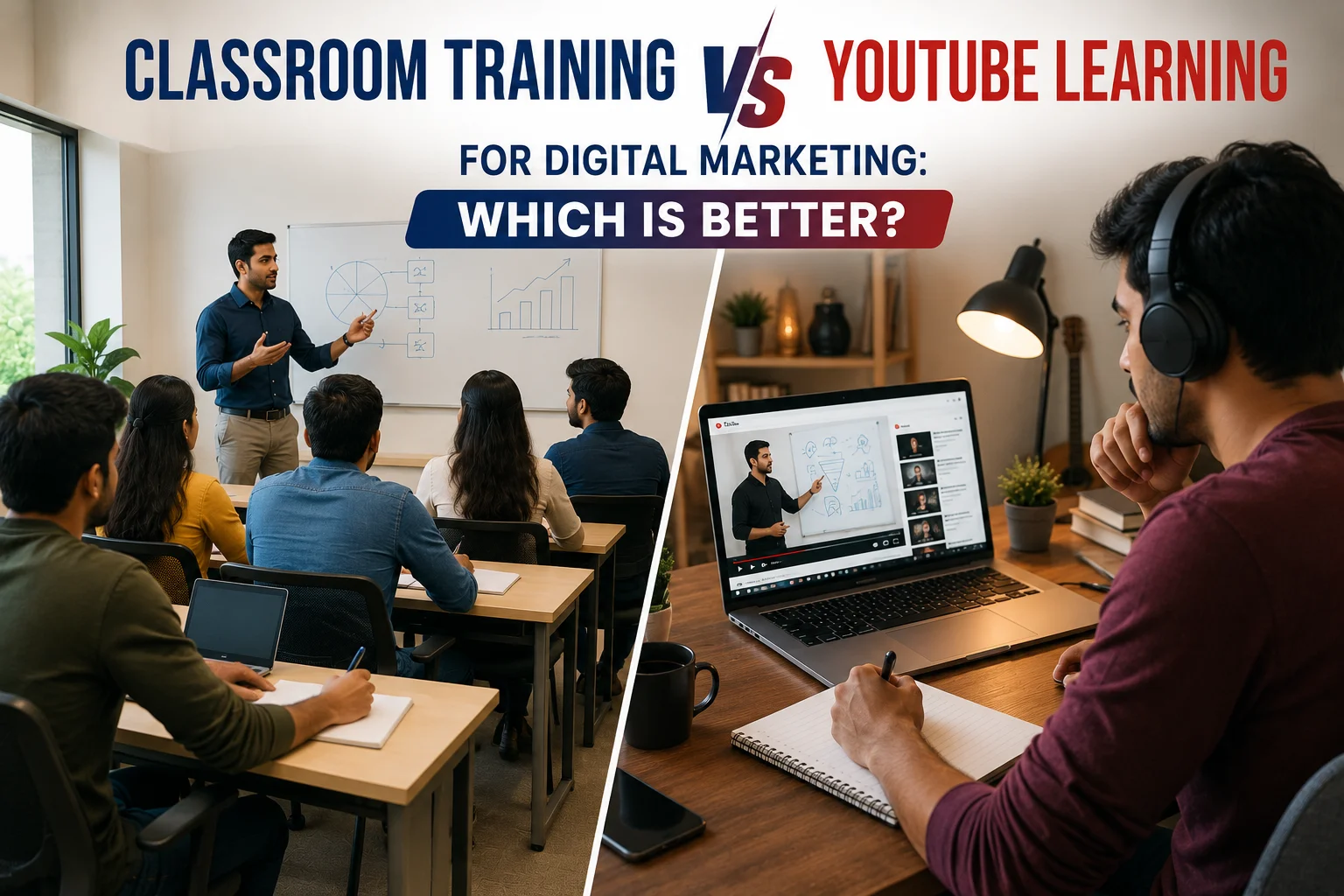
Every year, thousands of students open YouTube, type “learn digital marketing,” and assume the rest will take care of itself. It’s free, it’s endless, and it feels productive. Three months later, many of the same students still can’t run a live Google Ads campaign, read a GA4 report, or explain their work in an interview.
This isn’t a knock on YouTube. It’s a genuinely useful place to understand what digital marketing is. The problem shows up when learners try to use it as their only path to becoming job-ready. Employers and clients don’t hire people who’ve watched tutorials — they hire people who’ve managed budgets, fixed broken campaigns, and delivered results under real constraints.
That’s the actual gap this article is about: not “is YouTube good or bad,” but what separates someone who has watched digital marketing from someone who can do digital marketing course in pune professionally.
Understanding digital marketing is only the first step. Becoming job-ready requires structured learning, practical experience, expert mentorship, and the ability to deliver results in real-world campaigns.
Classroom digital marketing training is a structured learning approach where students receive guided instruction, hands-on assignments, mentorship, live campaign exposure, and career support. Unlike self-paced YouTube learning, it follows a defined curriculum built to produce job-ready, agency-capable professionals rather than passive viewers.
Comparison Table
| Learning Factor | YouTube Learning | Classroom Training |
|---|---|---|
| Structured Curriculum | Rarely, videos are scattered | Yes, sequential and goal-based |
| Mentorship | None | Direct access to trainers |
| Career Guidance | Not available | Built into the program |
| Placement Assistance | Not available | Usually included |
| Live Projects | Uncommon | Core part of training |
| Practical Assignments | Optional, self-driven | Mandatory, reviewed |
| Updated Content | Inconsistent, often outdated | Regularly refreshed |
| Industry Tools | Rarely hands-on | Practiced directly |
| Networking | Minimal | Peers, mentors, alumni |
| Certifications | Self-claimed | Institute + platform-issued |
| Doubt Solving | Comments section, delayed | Real-time, in person |
| Discipline | Depends entirely on the learner | Built into schedule |
| Learning Speed | Slow due to trial and error | Faster with guided structure |
| Portfolio Building | Left to the student | Actively supported |
| Interview Preparation | Not covered | Mock interviews included |
| Job Readiness | Low without extra effort | High by design |
| Salary Growth Potential | Uncertain | Higher with proof of work |
| ROI | Time-heavy, outcome unclear | Time-efficient, outcome-focused |
Why Most Students Choose YouTube
YouTube is usually the first stop for anyone curious about digital marketing, and there are real reasons it’s popular.
It’s free. There’s no financial commitment, which makes it the lowest-risk way to explore whether digital marketing even interests you.
It’s flexible. Videos can be watched at midnight, on a lunch break, or in five-minute bursts between college classes or a day job.
The content library is massive. Nearly every platform — Google Ads, Meta Ads, SEO, email marketing — has thousands of tutorials covering basics to advanced tricks.
It’s convenient. No enrollment, no schedule, no commute. You open the app and start watching.
For casual exploration or picking up a single skill, these advantages are genuinely valuable. The trouble starts when convenience is mistaken for competence.
The difference between classroom training and YouTube learning isn’t access to information—it’s access to structured guidance, practical experience, expert feedback, and career-focused learning.
What is the biggest limitation of YouTube-only learning?
The biggest limitation is the absence of structure. Videos are created independently by different creators with different goals, so there’s no guarantee they build on each other or lead anywhere specific.
Beyond structure, several other problems compound over time.
- Random videos, no curriculum: A student might learn Meta Ads targeting on Monday and jump to SEO backlinks on Tuesday, with no logical sequence connecting the two.
- No accountability: There’s no one checking whether assignments are done correctly, or done at all.
- Outdated tutorials: Platforms like Google Ads, Meta Business Suite, and GA4 change frequently; a video from two years ago may show interfaces and features that no longer exist.
- No mentorship: When a campaign underperforms, there’s no mentor to diagnose why.
- No feedback loop: Self-assessment is unreliable — most beginners can’t tell a good campaign strategy from a weak one.
- Algorithm distraction: Recommended videos pull attention toward unrelated or lower-quality content.
- No real projects: Watching someone else run a campaign is not the same as managing a live budget.
- No placement support: YouTube has no mechanism to connect learners with employers.
- No interview preparation: Technical knowledge without communication practice often fails at the interview stage.
- No certification value: Completing a playlist isn’t verifiable or recognized by employers.
- No networking: There’s no cohort, no alumni community, no peer accountability.
None of this means YouTube has no value. It means YouTube alone rarely produces someone who can walk into an agency or a client meeting and perform.
The biggest limitation of YouTube-only learning isn’t the quality of the content—it’s the lack of structure, mentorship, hands-on practice, and feedback needed to develop real-world digital marketing skills.
Why Classroom Training Builds Job-Ready Skills Faster
What makes classroom training more effective for career readiness?
Classroom training is more effective because it combines structured learning with direct feedback and real accountability, which compresses the time it takes to become genuinely employable.
A well-designed classroom program typically includes:
- A structured roadmap that moves from fundamentals to advanced execution in a logical order
- Assignments reviewed by trainers, not left to self-judgment
- Daily practice on real tools instead of passive video-watching
- Faculty guidance to correct mistakes before they become habits
- Industry tools like Google Ads, GA4, Google Tag Manager, and Looker Studio used hands-on
- Live campaigns where students manage actual budgets and audiences
- Case studies that mirror real client problems
- Agency workflow exposure, including reporting cycles and client communication
- Interview practice through mock sessions
- Resume and portfolio support built around completed work
- Soft skills development, including presentation and client-facing communication
The core difference isn’t the information itself — most of it is publicly available somewhere. The difference is sequencing, correction, and accountability, which is exactly what self-paced learning struggles to provide.
Practical Skills Employers Actually Want
Employers hiring for digital marketing roles consistently look for hands-on competency in:
- SEO — on-page, technical, and content optimization
- Google Ads — campaign structuring, bidding strategy, and budget management
- Meta Ads — audience targeting, Advantage+ campaigns, and creative testing
- GA4 — event tracking, conversion analysis, and reporting
- Google Tag Manager — tag, trigger, and variable setup
- WordPress — website structure and on-page SEO implementation
- Local SEO — Google Business Profile optimization and local ranking factors
- Performance Marketing — ROAS-focused, data-driven campaign execution
- Content Marketing — planning and producing content that supports SEO and brand goals
- Email Marketing — segmentation, automation, and campaign performance
- Analytics — interpreting data across GA4, Looker Studio, and ad platforms
- AI Tools — using tools like ChatGPT and Canva to speed up research, content, and creative work
A student who can list these skills is different from a student who can demonstrate them in a live dashboard. Classroom training is built around the second outcome.
Classroom Learning vs YouTube: A Detailed Comparison
| Parameter | YouTube Learning | Classroom Training |
|---|---|---|
| Learning Path | Unstructured, self-selected | Curriculum-driven |
| Feedback | Absent or delayed | Immediate and specific |
| Real Account Access | Rare | Common, supervised |
| Industry Relevance | Varies by creator | Aligned to current market needs |
| Accountability System | None | Attendance, assignments, evaluations |
| Peer Learning | Minimal | Cohort-based discussion and projects |
| Career Services | None | Resume, mock interviews, placement help |
| Skill Verification | Self-reported | Assessed and certified |
| Time to Job-Readiness | Unpredictable | Defined program duration |
Classroom training accelerates career readiness by combining structured learning, hands-on practice, expert mentorship, and continuous feedback—helping students build the practical skills employers value most.
YouTube can teach the theory behind campaign management, but it cannot replicate the judgment required to manage a live account under real budget and performance pressure.
Several skills are especially difficult to develop without guided, hands-on practice:
- Campaign troubleshooting — diagnosing why a Google Ads or Meta Ads campaign underperforms requires pattern recognition built through repeated real exposure.
- Client communication — explaining a dip in performance to a client is a skill that no tutorial rehearses.
- Reporting — building a Looker Studio dashboard that actually answers business questions takes practice, not just knowledge of the interface.
- Budget optimization — reallocating spend across campaigns in real time depends on judgment, not a formula from a video.
- Audience research — understanding a specific market segment goes beyond generic targeting tips.
- Live account management — permissions, account structure, and platform quirks vary in ways tutorials rarely cover.
- Agency workflow — coordinating with designers, content teams, and clients on deadlines.
- Team collaboration — working inside a shared account or campaign with defined roles.
- Client presentations — translating data into a narrative a non-marketer can understand.
These are the skills that separate a resume that lists tools from a resume backed by proof of work.
Real Cost Comparison
On paper, YouTube looks free and classroom training looks like an expense. The full picture is more nuanced.
Free learning costs no money upfront, but the hidden cost is time — often many more months of trial and error to reach a usable skill level, with no guarantee of reaching it at all.
Paid certifications and courses cost money but compress the learning curve significantly through structure, mentorship, and practical exposure.
Time investment matters because months spent watching disconnected content without feedback often need to be partially relearned once a student enters a structured environment or a job.
Opportunity cost is the income or career progress lost while a self-taught learner struggles to prove their skills without a portfolio or credible proof of work.
Career growth and salary impact tend to favor those who can demonstrate live project experience, agency-style workflow familiarity, and interview readiness — all of which classroom training is specifically designed to produce.
Placement support, when included, removes a major cost that self-taught learners bear alone: the time and uncertainty of the job search itself.
Viewed this way, classroom training is often not more expensive — it’s differently expensive, trading upfront cost for reduced time-to-income and reduced risk.
Why are live projects considered essential in digital marketing training?
Live projects are essential because they expose learners to real data, real constraints, and real mistakes — the exact conditions a job will demand, which no tutorial can simulate.
- Experience comes from managing something with real consequences, not from observing someone else do it.
- Confidence builds when a student has already handled a live budget before their first job interview.
- Mistakes made in a supervised live project become lessons; the same mistakes made alone, without feedback, often go unnoticed.
- Optimization skills develop through iterating on real underperforming campaigns, not through watching a polished walkthrough.
- Real data behaves unpredictably compared to demo data used in tutorials, and learning to read it is a skill in itself.
- Client scenarios — even simulated ones — teach negotiation, expectation-setting, and reporting in ways passive content cannot.
Digital marketing expertise isn’t built by watching campaigns—it’s built by managing real budgets, solving real problems, analyzing real data, and learning from real outcomes.
How Digital Scope Training Institute Bridges This Gap

Digital Scope Training Institute, a digital marketing training institute based in Pune, approaches this gap through a classroom-first, practice-heavy model rather than a lecture-only format. The structure is built around the same weaknesses this article has outlined in self-paced learning.
Training is delivered through structured classroom sessions led by experienced mentors, following a sequence rather than a scattered set of topics. Students work through agency-style practical training, which means assignments are modeled on real client scenarios instead of isolated exercises.
Live projects form a core part of the program, giving students exposure to actual campaigns across Google Ads, Meta Ads, SEO, and Performance Marketing before they ever apply for a job. Analytics training covers GA4, Google Tag Manager, and Looker Studio, so students can both run campaigns and report on them clearly.
The curriculum also includes WordPress for website and on-page SEO implementation, along with guidance for students interested in freelancing or supporting business marketing independently after the course. Career preparation is treated as part of the curriculum, not an afterthought — this includes resume building, mock interviews, and placement assistance, along with ongoing career mentoring as students transition into roles.
The institute has also incorporated an AI-powered digital marketing curriculum, reflecting how tools like ChatGPT and Canva are now part of everyday marketing workflows rather than optional extras. The goal throughout is educational: closing the specific gaps — structure, mentorship, live practice, and career support — that self-paced learning on its own struggles to close.
Career-ready digital marketers are built through structured learning, live projects, expert mentorship, and continuous practice—not by theory alone. That’s the gap Digital Scope Training Institute is designed to bridge.
Who Should Choose Classroom Training
Classroom training tends to be the better fit for:
- Students who want a defined path instead of piecing together fragmented content
- Freshers entering the job market with no prior marketing exposure
- Job seekers who need proof of practical skill, not just theoretical knowledge
- Working professionals switching into digital marketing from an unrelated field
- Business owners who want to run their own marketing without hiring an agency
- Freelancers who need client-ready skills and confidence to manage real accounts
- Career switchers who don’t have years to spend on trial-and-error learning
If the goal is quick exploration or picking up one narrow skill, YouTube may be enough. If the goal is a career, structured training closes the gap faster.
Digital marketing is not a purely academic subject — it’s a practiced skill, closer to a trade than a theory course. Reading about SEO or watching a video on Google Ads bidding strategy builds vocabulary, but vocabulary isn’t the same as judgment.
Judgment comes from managing a real budget when performance dips unexpectedly, or explaining to a client why a campaign needs another two weeks before results stabilize. That kind of decision-making is shaped through repetition, feedback, and correction — the exact elements a classroom environment is structured to provide and self-paced content structurally cannot.
This is why hiring managers increasingly ask for portfolios and project walkthroughs instead of certificates alone. A structured training path, especially one with live projects, produces candidates who can answer those questions with specifics rather than generalities.
Common Mistakes Students Make
- Treating YouTube as a complete course instead of a supplementary resource
- Jumping between unrelated topics without finishing a coherent skill path
- Skipping practical assignments and only consuming content passively
- Ignoring analytics and reporting skills in favor of only learning campaign setup
- Not building a portfolio of real or simulated project work
- Underestimating interview preparation, assuming technical knowledge is enough
- Learning from outdated tutorials without verifying current platform interfaces
- Avoiding live account practice out of fear of making mistakes
- Not seeking mentorship or feedback on their work
- Expecting job offers based on certificates alone, without demonstrable skills
YouTube is a genuinely useful starting point for understanding what digital marketing involves, and it deserves credit for that. But understanding a subject and being job-ready in it are two different outcomes, and the gap between them is exactly where most self-taught learners get stuck — no structure, no feedback, no live practice, no career support.
Classroom training closes that gap by design: a defined curriculum, direct mentorship, live projects, and career preparation built into the process rather than left to chance. For anyone genuinely pursuing digital marketing as a career — not just a hobby — that structured path tends to be the shorter, more reliable route to actually being hired.
Digital marketing isn’t mastered by consuming more content—it’s mastered by applying knowledge, solving real problems, and gaining experience through structured learning and continuous practice.
Frequently Asked Questions
Is YouTube enough to learn digital marketing?
YouTube can teach concepts and basic tool usage, but it typically lacks structure, mentorship, live projects, and feedback — all of which are important for becoming job-ready in digital marketing.
What is the main difference between classroom training and YouTube learning?
Classroom training offers structured curriculum, mentorship, live projects, and career support, while YouTube offers free, flexible, but unstructured and self-paced content.
Can I get a job in digital marketing by only watching YouTube videos?
It’s possible but difficult, since employers usually look for demonstrated project experience, portfolio work, and interview readiness that self-paced viewing alone rarely provides.
Why is classroom training considered faster for building job-ready skills?
Classroom training compresses learning time through structured sequencing, immediate feedback, and hands-on practice, reducing the trial-and-error period typical of self-taught learning.v
Do digital marketing institutes offer live project experience?
Many structured programs, including agency-style institutes, include live projects where students manage real or real-world-style campaigns before entering the job market.
Is classroom digital marketing training worth the cost compared to free YouTube content?
For career-focused learners, classroom training often reduces time-to-income and improves job readiness, which can offset the upfront cost compared to prolonged self-taught learning.
What skills do employers look for in digital marketing candidates?
Employers typically look for hands-on skills in SEO, Google Ads, Meta Ads, GA4, Google Tag Manager, WordPress, and performance marketing, along with reporting and analytical ability.
Is digital marketing a good career choice in 2026?
Digital marketing remains in demand as businesses continue shifting budgets toward online channels, making practical skills in SEO, paid ads, and analytics valuable across industries.
Are certifications from digital marketing institutes valuable?
Certifications combined with demonstrated project work and practical skills tend to carry more weight with employers than self-claimed knowledge alone.
What makes Digital Scope Training Institute different from generic online content?
Digital Scope Training Institute combines structured classroom learning, live projects, agency-style practical training, and career support such as mock interviews and placement assistance, addressing gaps that unstructured content typically leaves open.
Conclusion
Choosing between YouTube and classroom training isn’t really about picking a side — it’s about matching the learning method to the goal. Casual curiosity can start on YouTube. A serious career usually needs more: structure, mentorship, live projects, and support that self-paced content isn’t built to offer.
For students, freshers, career switchers, and professionals serious about entering digital marketing, a structured program like the one offered by Digital Marketing Course can shorten the path considerably. Explore specific tracks like the SEO Course, Google Ads Course, or Performance Marketing Course, to understand which path fits your background and goals.