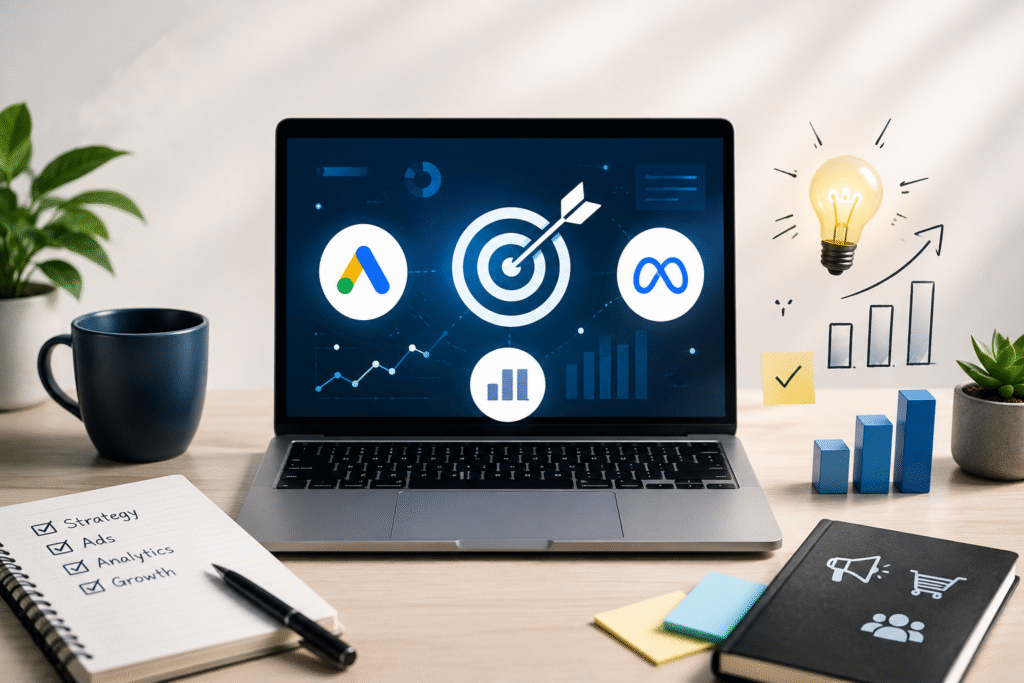
A performance marketing course in Pune is a practical digital marketing program that teaches paid advertising, campaign optimization, conversion tracking, and analytics across platforms such as Google Ads and Meta Ads. It is designed to help students run, measure, and improve ad campaigns rather than just understand marketing theory.
Most digital marketing training programs teach Google Ads, Meta Ads, and analytics as separate, disconnected topics. In real performance marketing work, these three areas function as one system: ads generate traffic, analytics measures that traffic, and tracking data is used to optimize future campaigns. This article explains what a performance marketing course in Pune should cover, how Google Ads and Meta Ads work together with analytics, and what to look for before enrolling.
Digital Scope Training Institute offers performance marketing training in Pune that combines Google Ads, Meta Ads, GA4, conversion tracking, and campaign optimization through practical, project-based learning
Performance marketing is not just about running ads—it’s about connecting Google Ads, Meta Ads, conversion tracking, and analytics to understand what works, optimize campaigns, and generate measurable business results. A practical performance marketing course in Pune should therefore focus on hands-on campaign management, tracking, data analysis, and continuous optimization.
What Is Performance Marketing?
Performance marketing is a form of digital advertising where results are tracked and measured through specific actions, such as clicks, leads, or sales, rather than just impressions or reach.
Unlike traditional advertising, performance marketing focuses on measurable outcomes. Marketers set up campaigns on platforms like Google Ads and Meta Ads, track user actions through tools like Google Analytics 4 (GA4) and Google Tag Manager (GTM), and continuously optimize based on data such as cost per lead (CPL), cost per acquisition (CPA), and return on ad spend (ROAS).
Key Takeaway: Performance marketing is defined by measurement and optimization. A campaign is only “performance marketing” if its results are tracked and used to improve future decisions.
Why Learn Performance Marketing in Pune?
Pune has a growing base of startups, D2C brands, IT companies, agencies, and small businesses that rely on paid advertising for lead generation and sales. This creates consistent local demand for professionals who can manage Google Ads and Meta Ads campaigns.
Learning performance marketing in Pune, through classroom-based or hybrid training, gives students the advantage of hands-on practice, direct doubt-solving, and exposure to real campaign scenarios rather than only pre-recorded video content.
Reasons Pune is a practical location to learn performance marketing include:
- A large base of digital agencies and marketing teams that hire PPC and paid media talent
- Growing demand from D2C and ecommerce businesses for paid acquisition specialists
- Access to classroom-based, project-driven training options
- A strong IT and startup ecosystem that regularly needs in-house performance marketers
Performance marketing is a data-driven approach where advertising decisions are based on measurable results such as leads, sales, conversions, CPL, CPA, and ROAS. For learners in Pune, practical training in Google Ads, Meta Ads, GA4, GTM, and campaign optimization can help bridge the gap between digital marketing theory and real-world performance marketing work.
What Does a Performance Marketing Course Teach?
A well-structured performance marketing course covers five connected areas: Google Ads, Meta Ads, analytics, conversion tracking, and campaign optimization.
Google Ads
Google Ads training typically covers Search Ads, Display Ads, and Performance Max campaigns. Students learn how keyword intent affects targeting, how bidding strategies work, and how to set up conversion tracking to measure campaign results.
Meta Ads
Meta Ads training covers advertising across Facebook and Instagram, including audience targeting, creative testing, lead generation campaigns, and retargeting. Students learn how to structure campaigns for different objectives such as awareness, traffic, or conversions.
Analytics & Measurement
Analytics training focuses on GA4, Google Tag Manager, and Looker Studio. Students learn to track user behavior, set up events and conversions, and build reporting dashboards that summarize campaign performance.
Conversion Tracking
Conversion tracking involves setting up pixels, tags, and UTM parameters so that actions like form submissions, purchases, or sign-ups can be attributed to specific campaigns and ads.
Campaign Optimization
Optimization involves analyzing metrics such as CTR, CPC, CPL, CPA, and ROAS to identify underperforming ads, adjust targeting, and reallocate budget toward better-performing campaigns.
A performance marketing course should combine paid advertising, analytics, tracking, and optimization rather than teaching advertising platforms in isolation.
A practical performance marketing course should teach more than ad-platform operation. Students should learn how to plan campaigns, track conversions, analyze performance data, test creatives and audiences, and optimize budgets across Google Ads and Meta Ads to achieve measurable business outcomes.
Google Ads vs Meta Ads: What Is the Difference?
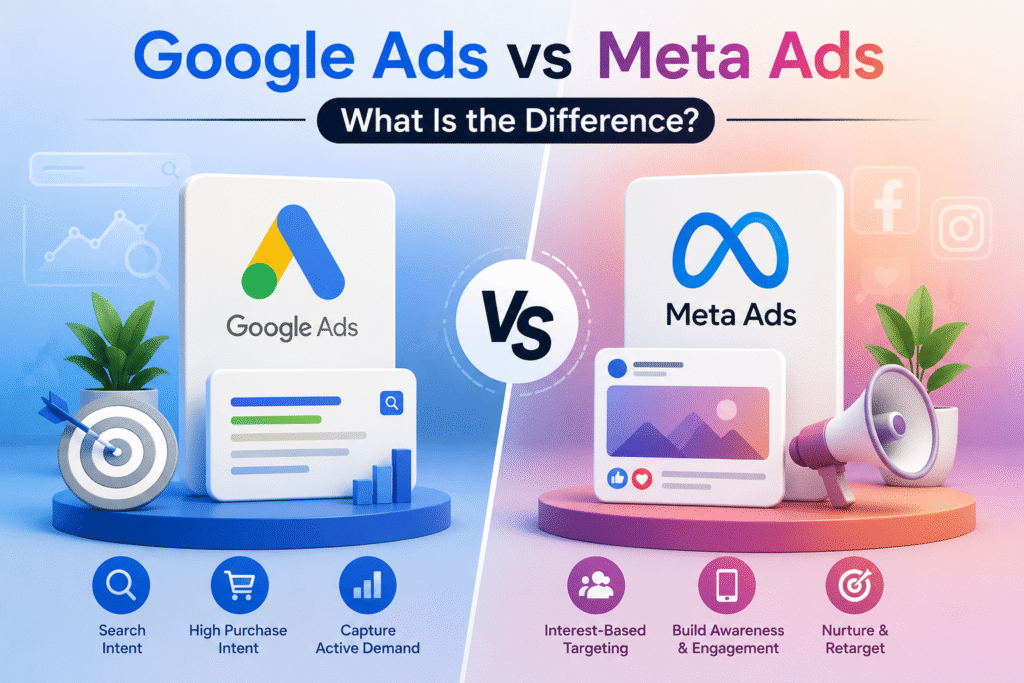
Google Ads and Meta Ads serve different purposes within a performance marketing strategy, and understanding both is more valuable than specializing in only one.
| Factor | Google Ads | Meta Ads |
|---|---|---|
| Platform Type | Search and display network | Facebook and Instagram |
| Primary Intent | Intent-based (users actively searching) | Interest and behavior-based |
| Ad Formats | Search, Display, Performance Max | Image, video, carousel, lead ads |
| Targeting Basis | Keywords and search terms | Demographics, interests, behavior |
| Best For | Capturing existing demand | Building awareness and generating leads |
| Optimization Focus | Keyword and bid optimization | Audience and creative optimization |
Google Ads primarily captures existing demand by reaching users who are actively searching, while Meta Ads helps create and influence demand through audience targeting and engaging creatives. A strong performance marketer should understand when to use each platform and how to combine both for better acquisition results.
Why Combine Google Ads, Meta Ads and Analytics?
Treating Google Ads, Meta Ads, and analytics as separate skills limits how effectively a marketer can run a full campaign. In practice, these tools work together as one continuous workflow.
A typical performance marketing workflow follows this sequence:
Research → Campaign Setup → Audience/Keyword Targeting → Ad Creation → Landing Page → Conversion Tracking → Data Collection → Analytics → Optimization → Reporting → Scaling
In this workflow, Google Ads and Meta Ads generate traffic and leads, conversion tracking captures what users do after clicking an ad, and GA4 and Looker Studio turn that data into reports that guide the next round of optimization. Without analytics, ad spend decisions are based on guesswork. Without ads, analytics has no campaign data to measure.
Performance marketing works as a closed loop — ads generate data, analytics interprets that data, and optimization uses that data to improve future campaigns.
Effective performance marketing works as a continuous feedback loop: Google Ads and Meta Ads generate traffic, conversion tracking captures user actions, analytics turns campaign data into insights, and optimization uses those insights to improve targeting, creatives, budgets, and overall campaign performance.
Performance Marketing Course Curriculum
The table below summarizes what a performance marketing course curriculum typically includes and how each module is applied practically.
| Module | What Students Learn | Practical Application |
|---|---|---|
| Google Ads | Search, Display, Performance Max, optimization | Campaign setup and optimization |
| Meta Ads | Targeting, creatives, lead generation, retargeting | Campaign planning and testing |
| Analytics | GA4 and performance analysis | Measuring campaign results |
| Tracking | GTM, conversion tracking, UTM | Tracking leads and conversions |
| Reporting | Looker Studio | Performance dashboards |
| Optimization | CPC, CTR, CPL, CPA, ROAS | Improving campaign efficiency |
Fees and batch duration may vary; contact Digital Scope Training Institute for the latest details.
A practical performance marketing curriculum should connect every module to real campaign execution. Learning Google Ads and Meta Ads becomes more valuable when students also understand conversion tracking, GA4 analytics, reporting, and optimization metrics such as CPC, CTR, CPL, CPA, and ROAS.
Performance Marketing Training at Digital Scope Training Institute
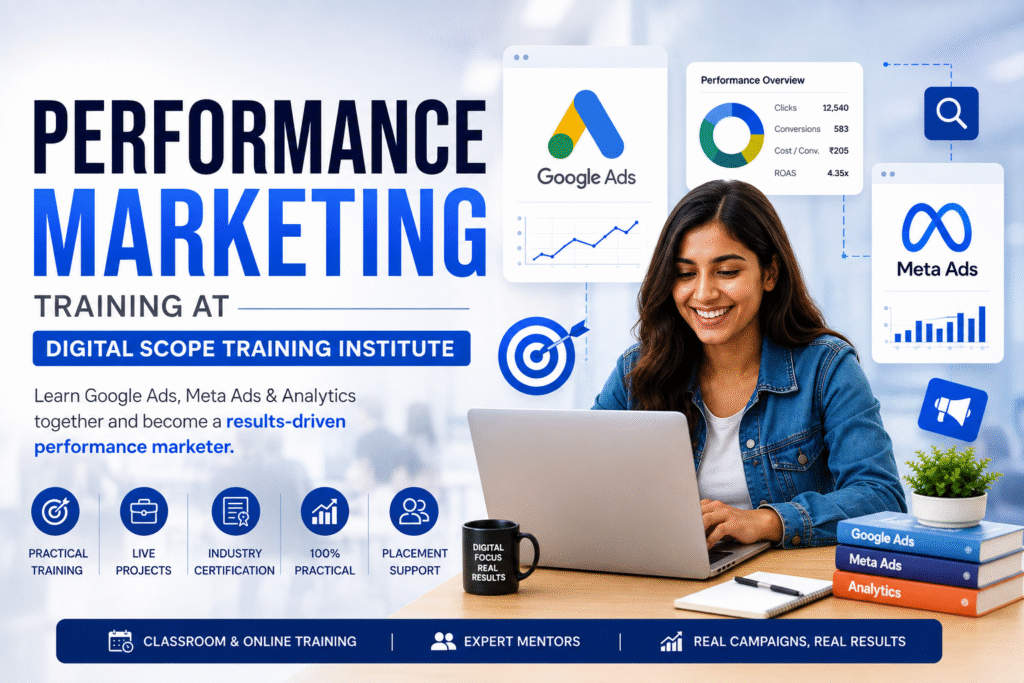
Digital Scope Training Institute is based in Pune and follows a classroom-first, practical training approach for performance marketing. The digital marketing course in pune structure is built around hands-on campaign work rather than passive video lectures.
Training at Digital Scope Training Institute is centered on:
- Google Ads, including Search, Display, and Performance Max campaigns
- Meta Ads across Facebook and Instagram, including lead generation and retargeting
- GA4, Google Tag Manager, and Looker Studio for measurement and reporting
- Conversion tracking and UTM parameter setup
- Campaign optimization based on real performance metrics
- Landing page fundamentals and exposure to WordPress where relevant
- Agency-style practical exposure to campaign planning and execution
- Awareness of how AI tools are used in modern digital marketing workflows
The institute also places emphasis on job readiness by focusing on practical, tool-based skills that employers typically evaluate during hiring.
Digital marketing training becomes more valuable when students learn by doing. A practical, classroom-first approach that combines Google Ads, Meta Ads, GA4, GTM, Looker Studio, conversion tracking, and campaign optimization can help learners build the hands-on skills needed to manage real performance marketing campaigns.
Who Should Learn Performance Marketing?
Performance marketing training is relevant to a wide range of learners, not only marketing graduates.
| Suitable For | Why It Applies |
|---|---|
| Freshers | Builds a practical, in-demand skill set for entry-level roles |
| Working Professionals | Adds paid media and analytics skills to an existing marketing background |
| Freelancers | Enables independent handling of client ad campaigns |
| Business Owners | Allows direct management of ad budgets without outsourcing |
| Career Switchers | Provides a structured path into digital marketing roles |
Performance marketing skills apply equally to job seekers, business owners managing their own ad budgets, and freelancers offering paid media services to clients.
Performance marketing is a practical skill set that can benefit freshers, working professionals, freelancers, business owners, and career switchers. Whether the goal is to build a career, manage client campaigns, or improve in-house advertising, learning paid media, analytics, tracking, and optimization provides a strong foundation for measurable digital marketing.
What Skills Do Employers Look for in Performance Marketers?
Employers hiring for performance marketing roles typically evaluate practical, demonstrable skills rather than only theoretical knowledge.
Commonly evaluated skills include:
- Ability to set up and manage Google Ads and Meta Ads campaigns
- Understanding of conversion tracking and tagging (GTM, pixels, UTM)
- Comfort reading and interpreting GA4 reports
- Ability to build reporting dashboards in Looker Studio
- Understanding of key metrics: CTR, CPC, CPL, CPA, ROAS
- Basic understanding of landing pages and how they affect conversions
- Ability to test and optimize ad creatives and audience targeting
Career Opportunities After Performance Marketing Training
Performance marketing skills apply to several roles across agencies, businesses, and freelance work.
Roles that commonly require performance marketing skills include:
- Performance Marketing Executive
- PPC Executive
- Google Ads Specialist
- Paid Media Executive
- Meta Ads Specialist
- Digital Marketing Executive
- Performance Marketing Analyst
- Paid Acquisition Specialist
These roles typically require hands-on campaign management experience, familiarity with analytics tools, and the ability to interpret performance data to guide decisions. No specific salary, placement outcome, or hiring guarantee should be assumed from training alone; outcomes depend on individual skill development, portfolio, and market conditions.
A successful performance marketing career requires more than knowing how to launch ads. Employers value professionals who can connect campaign setup with conversion tracking, analytics, reporting, testing, and optimization—and use performance data to make informed marketing decisions.
How to Choose a Performance Marketing Course in Pune?
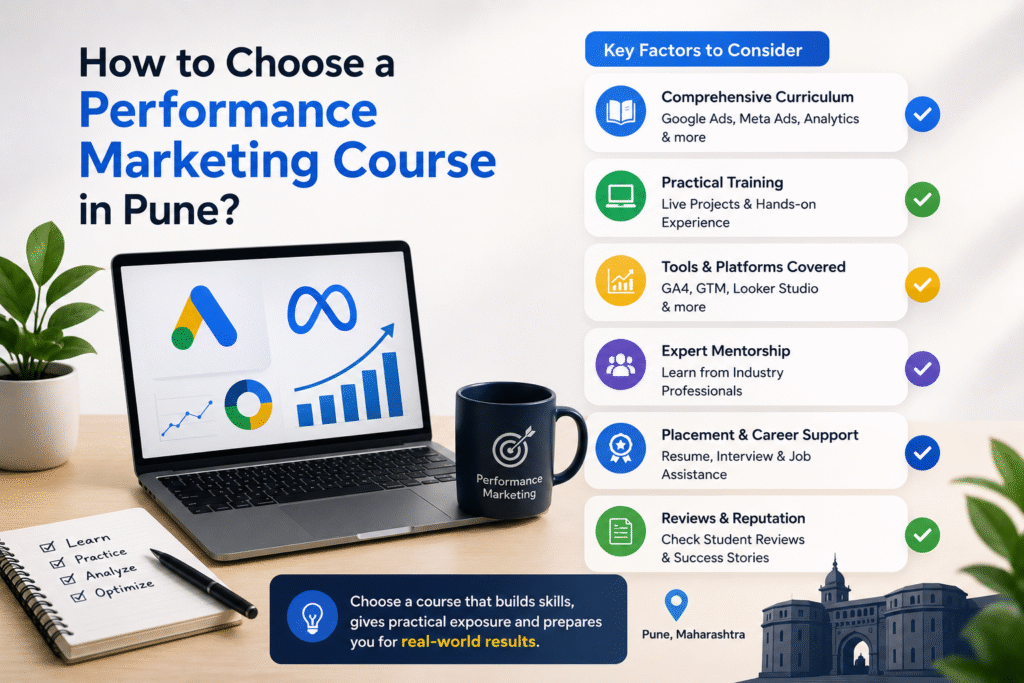
Before choosing a performance marketing course in Pune, it helps to check whether the curriculum covers both the advertising platforms and the measurement tools needed to run full campaigns.
Before choosing a performance marketing course in Pune, check whether it includes:
- Google Ads practical training — needed to run search and display campaigns confidently
- Meta Ads practical training — needed for Facebook and Instagram campaign management
- GA4 — required to measure user behavior and campaign outcomes
- Google Tag Manager — needed to implement tracking without constant developer support
- Conversion tracking — essential for measuring leads, sales, and sign-ups accurately
- UTM tracking — needed to identify which campaigns and channels drive results
- Campaign optimization — the core skill that separates performance marketing from basic ad posting
- Live/practical projects — builds real campaign experience, not just theory
- Reporting and dashboards — needed to present results clearly to clients or managers
- Landing page fundamentals — affects conversion rates directly
- Real-world campaign analysis — develops the ability to read data and make decisions
- Interview/career preparation — helps translate course learning into job readiness
How Performance Marketing Campaigns Are Measured
Performance marketing relies on a specific set of metrics to evaluate whether a campaign is working.
- CTR (Click-Through Rate): The percentage of people who click an ad after seeing it. Indicates how relevant or appealing an ad is.
- CPC (Cost Per Click): The average amount spent for each click on an ad.
- CPL (Cost Per Lead): The average cost to generate one lead, such as a form submission.
- CPA (Cost Per Acquisition): The average cost to acquire one customer or completed action.
- Conversion Rate: The percentage of users who complete a desired action after clicking an ad.
- ROAS (Return on Ad Spend): The revenue generated for every unit of currency spent on advertising.
No single metric tells the full story. CTR shows ad relevance, CPL and CPA show cost efficiency, and ROAS shows overall campaign profitability — all four should be reviewed together.
Practical Projects Students Should Work On
Practical, project-based learning is what differentiates performance marketing training from theoretical digital marketing courses.
Realistic project examples include:
- Setting up a Google Search Ads campaign for a sample local business
- Building a Meta Ads lead generation campaign with audience testing
- Installing GA4 and GTM on a test website and configuring conversion events
- Creating a UTM tracking sheet for a multi-channel campaign
- Building a Looker Studio dashboard summarizing campaign performance
- Analyzing a sample campaign’s CTR, CPC, CPL, and ROAS to recommend optimizations
- Performance marketing is defined by measurement and optimization, not just running ads.
- Google Ads and Meta Ads serve different purposes — search intent versus interest-based targeting — and are most effective when used together.
- Analytics and tracking connect advertising to real business outcomes, turning ad spend into measurable data.
- A performance marketing course in Pune should combine Google Ads, Meta Ads, GA4, GTM, and optimization rather than teaching them as isolated modules.
- Practical, project-based learning matters more than passive video content for building job-ready performance marketing skills.
- Metrics like CTR, CPC, CPL, CPA, and ROAS should be reviewed together, not in isolation, to judge campaign performance.
Choosing a performance marketing course should go beyond checking the number of modules. Look for practical training that connects Google Ads and Meta Ads with GA4, GTM, conversion tracking, reporting, and campaign optimization. The strongest learning experience is one where students can work on realistic campaigns, analyze metrics such as CTR, CPC, CPL, CPA, and ROAS, and use those insights to make data-driven decisions.
Frequently Asked Questions
What is a performance marketing course in Pune?
A performance marketing course in Pune is a training program that teaches paid advertising on platforms like Google Ads and Meta Ads, along with analytics, conversion tracking, and campaign optimization, using practical, hands-on learning methods.
What is taught in a performance marketing course?
A performance marketing course typically teaches Google Ads, Meta Ads, GA4, Google Tag Manager, conversion tracking, UTM parameters, Looker Studio reporting, and how to optimize campaigns using metrics like CTR, CPC, CPL, CPA, and ROAS.
Is Google Ads included in performance marketing?
Yes. Google Ads is a core component of performance marketing, covering Search Ads, Display Ads, and Performance Max campaigns, along with keyword targeting, bidding, and conversion tracking.
Is Meta Ads included in performance marketing?
Yes. Meta Ads, covering Facebook and Instagram advertising, is a core part of performance marketing, including audience targeting, creative testing, lead generation, and retargeting.
Why is GA4 important for performance marketing?
GA4 tracks user behavior and campaign outcomes after ad clicks, allowing marketers to measure conversions, analyze traffic sources, and make data-driven optimization decisions across Google Ads and Meta Ads campaigns.
Is performance marketing good for freshers?
Performance marketing can be a suitable field for freshers who want a practical, skill-based entry into digital marketing, especially when training includes hands-on platform practice rather than only theoretical concepts.
How long does it take to learn performance marketing?
Learning timelines vary based on the course structure and individual pace. Fees and batch duration may vary; contact Digital Scope Training Institute for the latest details.
What tools should a performance marketer learn?
Key tools include Google Ads, Meta Ads Manager, GA4, Google Tag Manager, Looker Studio, and basic UTM tracking practices for campaign attribution and reporting.
What career options are available after performance marketing training?
Common roles include Performance Marketing Executive, PPC Executive, Google Ads Specialist, Meta Ads Specialist, Paid Media Executive, and Performance Marketing Analyst, typically requiring hands-on campaign and analytics skills.
Does Digital Scope Training Institute offer performance marketing training in Pune?
Yes. Digital Scope Training Institute, based in Pune, offers performance marketing training covering Google Ads, Meta Ads, GA4, conversion tracking, and campaign optimization through practical, project-based learning.
Is practical experience important for performance marketing?
Yes. Performance marketing depends on hands-on campaign management, data interpretation, and continuous optimization, which are skills best developed through live projects rather than theoretical study alone.
Conclusion
Performance marketing works best when Google Ads, Meta Ads, and analytics are learned as one connected system rather than three separate subjects. Ads generate traffic and leads, tracking tools capture what happens after the click, and analytics turns that data into decisions that improve future campaigns. A performance marketing course in Pune that covers this full workflow, backed by practical, project-based learning, gives students a more realistic foundation for handling real campaigns. Digital Scope Training Institute’s performance marketing training in Pune is structured around this combined approach, covering Google Ads, Meta Ads, GA4, conversion tracking, and campaign optimization through hands-on practice.